
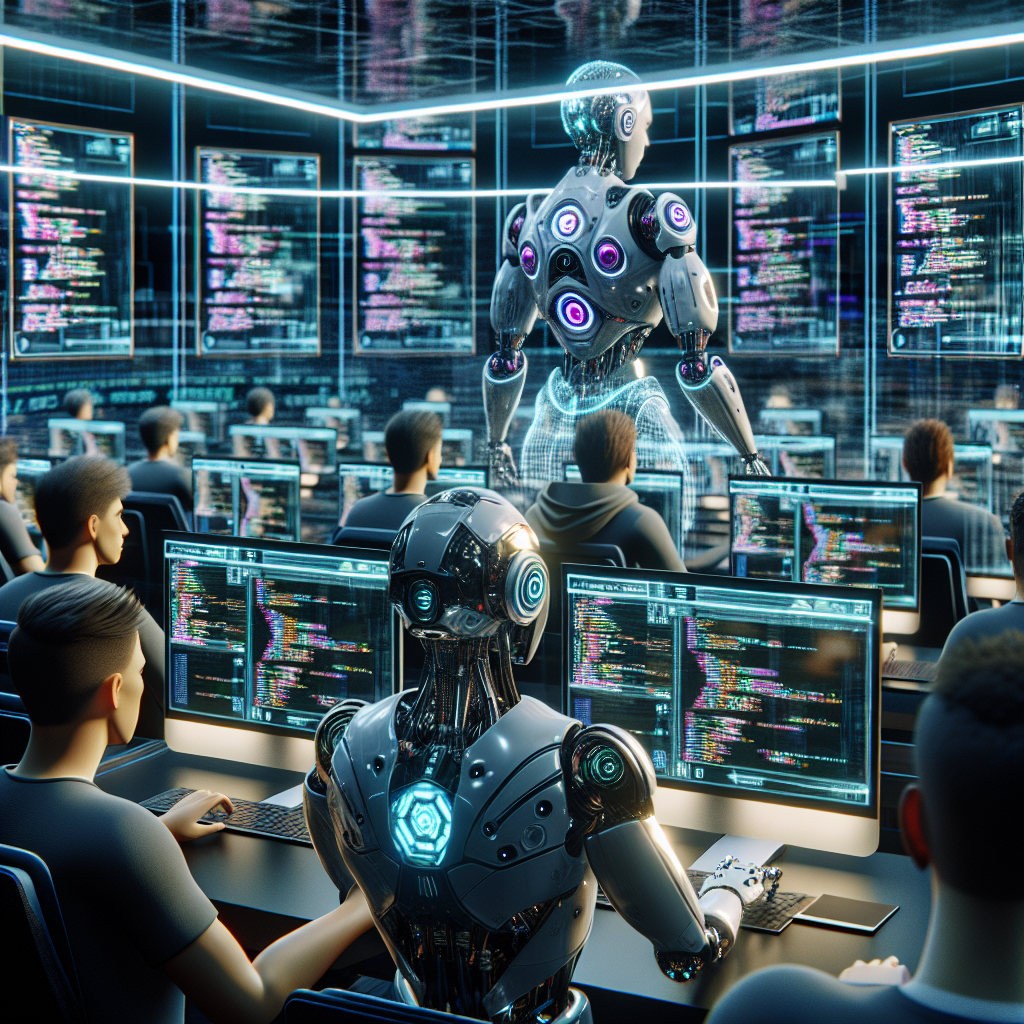
OpenAI’s AI Dominates Coding Contest, But One Human Wins
AI Outsmarts the Best—Well, Almost
In a groundbreaking moment for artificial intelligence and competitive programming, OpenAI’s powerhouse coding assistant, known as GPT-4, has once again proven its capabilities by competing against the world’s top human programmers—and nearly taking the crown. During a grueling 10-hour algorithmic coding contest hosted by Codeforces, OpenAI’s AI-powered system outperformed most participants, including veteran coding champions.
But amidst the stunning performance by AI, one human coder still managed to pull ahead and secure first place, underscoring the evolving but still-human edge in creativity, intuition, and adaptability.
The Epic Showdown: AI vs. Human Coders
The 10-hour Codeforces contest wasn’t just a casual face-off. It included complex algorithmic challenges that test logic, problem-solving skills, and quick coding abilities that typically only elite competitive programmers conquer. OpenAI entered the arena with its Codex-powered model—a specially trained version of GPT-4 optimized for software tasks—competing under the pseudonym “aicoder.”
This contest had:
- Classic algorithm problems
- Mathematical puzzles
- Edge-case-heavy challenges
- Abstraction-heavy logic tasks
The stakes were simple: compete just like the rest, with no special treatment—write code in real-time, debug errors, and submit problems to the online judge.
How the AI Performed
Over the 10-hour duration, OpenAI’s AI model scorched through problem after problem, completing complex coding tasks at a pace that left many seasoned coders awestruck. Most astonishingly, the AI scored higher than several Codeforces experts with International Grandmaster status—a title reserved only for the elite in global programming competitions.
Key highlights from the AI’s performance:
- Problem-solving speed: Solved early problems with lightning efficiency
- Error handling: Demonstrated near-perfect debugging on common runtime issues
- Endurance: Maintained high accuracy throughout the 10-hour stretch
According to OpenAI researchers, the model was not specifically trained for contest-style problem solving but adapted to the format incredibly well. This shows the growing capacity of AI to generalize its abilities even in niche and complex domains like competitive programming.
The Human Challenger Who Beat the Bot
Despite AI’s dominance in the leaderboard, one coder rose above: the human participant known by the handle “Radewoosh,” Bartosz Pawłowski from Poland—a highly respected coder in the competitive programming community. He scored slightly higher than the AI by making fewer submission attempts and optimizing his problem-solving workflow.
What gave Bartosz the edge?
Human intuition and strategy. While the AI model solved problems correctly, Bartosz used a higher-level strategic approach to select problems in order and minimize the number of attempts, giving him an efficiency advantage in the scoring rubric.
Differentiators in the top performance:
- Time management: Human was more selective in tackling complex problems
- Fewer submissions: Scoring was based partly on fewer wrong submissions (AI had more attempts)
- Experience: Years of competitive experience allowed him to navigate problem traps more gracefully
What This Means for the Future of Programming
This contest marks a turning point not just for AI technology, but also for software development and competitive programming. Where once machines were only peripheral aids for programmers, they are now legitimate contenders—and collaborators—in intellectual races.
Implications of this AI-human matchup:
- AI is reaching near-human problem-solving abilities
- Augmented coding is becoming a practical reality
- AI can support developer education by simulating real-world scenarios
Despite the loss, most top coders acknowledged AI’s ability not just to follow instructions, but build solutions from scratch and debug complex algorithmic issues. In fact, some even described using tools like GPT-4 as a way to extend their own problem-solving workflow in professional settings.
Why AI Didn’t Win—Yet
It’s important to point out that while AI’s performance was remarkable, it didn’t win outright. Why? Because contests like these reward not just right answers, but how those answers are arrived at. Penalties for incorrect submissions, time taken on each question, and strategic selection all play into final scores—factors that AI still struggles to optimize.
Limitations that played a role:
- Submission penalties: AI had higher submission counts, reducing overall score
- Lack of contest strategy: AI doesn’t fully grasp the nuance of prioritizing easier tasks or avoiding trap problems
- Context refresh issues: Unlike humans, AI occasionally mistreated earlier problems and had to re-calculate logic
This shows that while AI has come a long way, understanding context, intuition, and strategic thinking in dynamic environments still presents a challenge.
The Bigger Picture: Augmented Intelligence, Not Replacement
Instead of worrying about AI replacing programmers, this event highlights an evolving partnership between human and machine. Intelligent systems like GPT-4 are rapidly becoming essential companions for both learning and productivity. And when paired with a skilled human hand, they’re even more powerful.
How AI will change coding:
- Improve learning for new developers through code explanations
- Cut down software development and debugging time
- Enable more complex project planning and architecture
- Democratize access to programming knowledge globally
Coders today are already integrating these tools into daily work, from writing boilerplate code faster to reviewing pull requests more effectively with AI copilots.
Final Thoughts: A Rivalry Worth Watching
The 10-hour Codeforces showdown is a clear demonstration of how rapid advancements in AI are changing the landscape of competitive problem-solving. OpenAI’s GPT-4 model may not have claimed the top spot this time, but it more than proved its mettle in a domain once thought safe from automation.
As AI continues to evolve, one thing is clear: the future of programming will belong not to humans or machines alone, but to those who can leverage both.
In short: OpenAI’s AI dominated, but one brilliant mind still held the line—proving that while machine intelligence is surging ahead, the human touch still matters.