
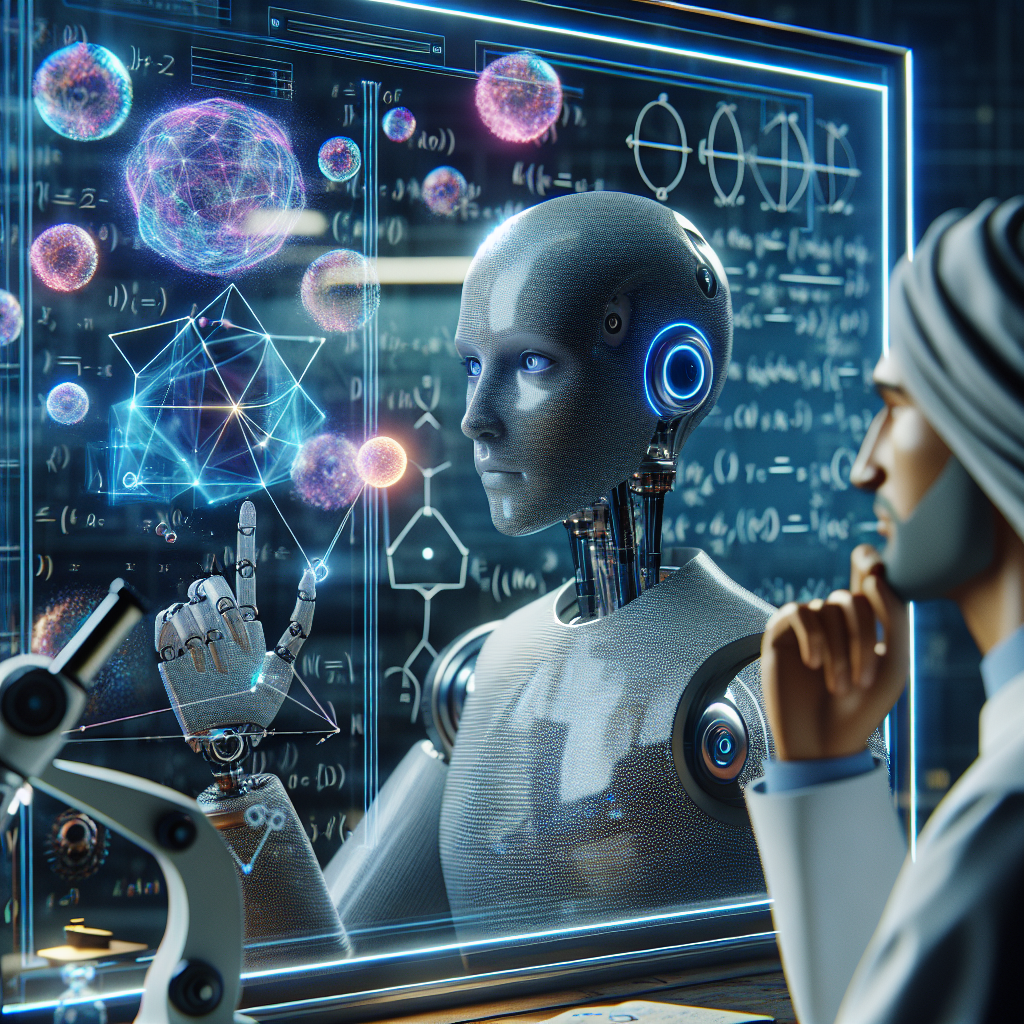
AI Designs Strange Physics Experiments That Surprisingly Succeed
A New Age of Scientific Discovery Powered by Artificial Intelligence
In recent years, artificial intelligence (AI) has made significant inroads into disciplines like medicine, art, finance—and now—physics. But rather than just accelerating known theoretical work, AI is starting to reshape the way we ask questions about the laws of the universe. Surprisingly, AI-generated experiments in physics are not only unconventional, but they also reveal new insights into systems we thought we understood.
Welcome to a new era where machines are not just helping scientists think—they are teaching them to think differently.
AI as a Creative Partner in Physics Research
In a ground-breaking study, researchers applied language-based AI models to create new types of physics experiments. These aren’t just minor variations of previous experiments. Instead, AI is proposing bizarre, non-intuitive setups that human scientists might dismiss as implausible—yet they work, and often yield novel data.
One such AI, built on large language models like GPT, was trained on volumes of physics literature before being tasked with designing experiments in quantum mechanics. To the researchers’ astonishment, the AI began constructing model-based reasons for structuring experiments in peculiar ways that challenged common assumptions—but the results were validated through simulation and, in some cases, real-world testing.
From Intuition to Machine “Imagination”
Traditionally, physics experiments are grounded in intuition—shaped by centuries of theoretical development. But AI isn’t encumbered by human intuition. It makes choices based on pattern recognition across vast datasets, unrestricted by human cognitive biases. This allows AI to:
- Propose unusual variable control setups
- Reorganize experimental steps in novel sequences
- Synthesize multiple physics concepts into unified experiments
- Explore “edge-case” physical systems that humans overlook
In one instance, the AI designed an experiment utilizing optical cavities in a way that had not been tested before. Where human researchers traditionally focused light in predictable paths, the AI suggested reshuffling the setup to test for properties assumed to be irrelevant—yet the experiment led to measurable quantum behavior, sparking new avenues of inquiry.
Validating the “Weird Science” of AI Proposals
Understandably, physicists were skeptical at first. How do you validate an experiment that looks like it came from a sci-fi novel? But rigorous testing, including simulation modeling and real-lab implementation, confirmed the surprising success of many designs proposed by AI.
Take for example:
- A harmonic oscillator experiment where the AI arranged quantum sensors asymmetrically
- A particle entanglement study that dropped classical coherence parameters
These aren’t just random guesses. They’re backed by patterns the AI identified in high-dimensional datasets that humans might overlook. When tested, they didn’t just align with known theory—they expanded it.
AI as a Hypothesis Generator
One of AI’s most powerful roles in physics research is acting as a hypothesis engine. Rather than taking the role of experiment executioner, it’s being nudged into the driver’s seat for conceptual design. This shifts the scientific method from:
“Here’s a theory—let’s test it”
to
“Here’s a surprising experiment—what can it tell us?”
This inversion has already led to exciting implications, including:
- The re-evaluation of certain quantum superposition laws
- Novel methods for isolating entangled systems
- More energy-efficient experiment layouts
Implications for the Future of Physics and Beyond
The rise of AI-designed physics experiments is more than a breakthrough—it’s a paradigm shift for science:
- Efficiency Gains: Design cycles for new experiments can be reduced from months to weeks
- Unbounded Curiosity: AI can generate thousands of oddball experiments that humans wouldn’t consider
- Risk-Friendly Exploration: Machines don’t fear failure, allowing for more radical hypothesis testing
More importantly, it opens doors to pushing boundaries in multidisciplinary research, merging physics with biology, chemistry, or cognitive science in ways that only a cross-referenced neural network could conceive.
Imagine experiments in dark matter detection being designed collaboratively between quantum algorithm AIs and telescopic data bots analyzing sky patterns. Or AIs that experiment with metamaterials’ structure while simultaneously interpreting results using language modeling.
Challenges and Ethical Considerations
While the upside of AI in experimental physics is immense, ethical and scientific caution must be exercised:
- Verification: Strange proposals must undergo stringent peer review and real-world testing
- Transparency: AI-generated reasoning can sometimes be opaque—explainability is crucial
- Bias Minimization: Training data must be curated to avoid reinforcing outdated or incorrect theories
Moreover, there’s an ongoing debate about credit attribution. If an AI proposes the experiment and it leads to a major discovery—who gets to claim it? The scientists? The AI designer? The machine?
Closing Thoughts: Rethinking What It Means to “Do Science”
For centuries, scientific progress has relied on the keen intellect and creativity of human minds. Now, AI subverts that notion—not by replacing scientists—but by becoming a catalyst for unconventional thinking.
AI-designed experiments in physics illustrate the promise of machine-assisted discovery: the ability to explore paths we would otherwise never walk down. As strange as some of these experiments may seem, they’re ushering in a richer, more diverse scientific world—one bizarre suggestion at a time.
In the words of one physicist involved in the project, “We’re not just teaching AI science anymore—AI is helping us redefine it.”
The future of physics may not lie solely in more powerful telescopes or particle colliders—but in the mind of a machine that dares to imagine the impossible.