
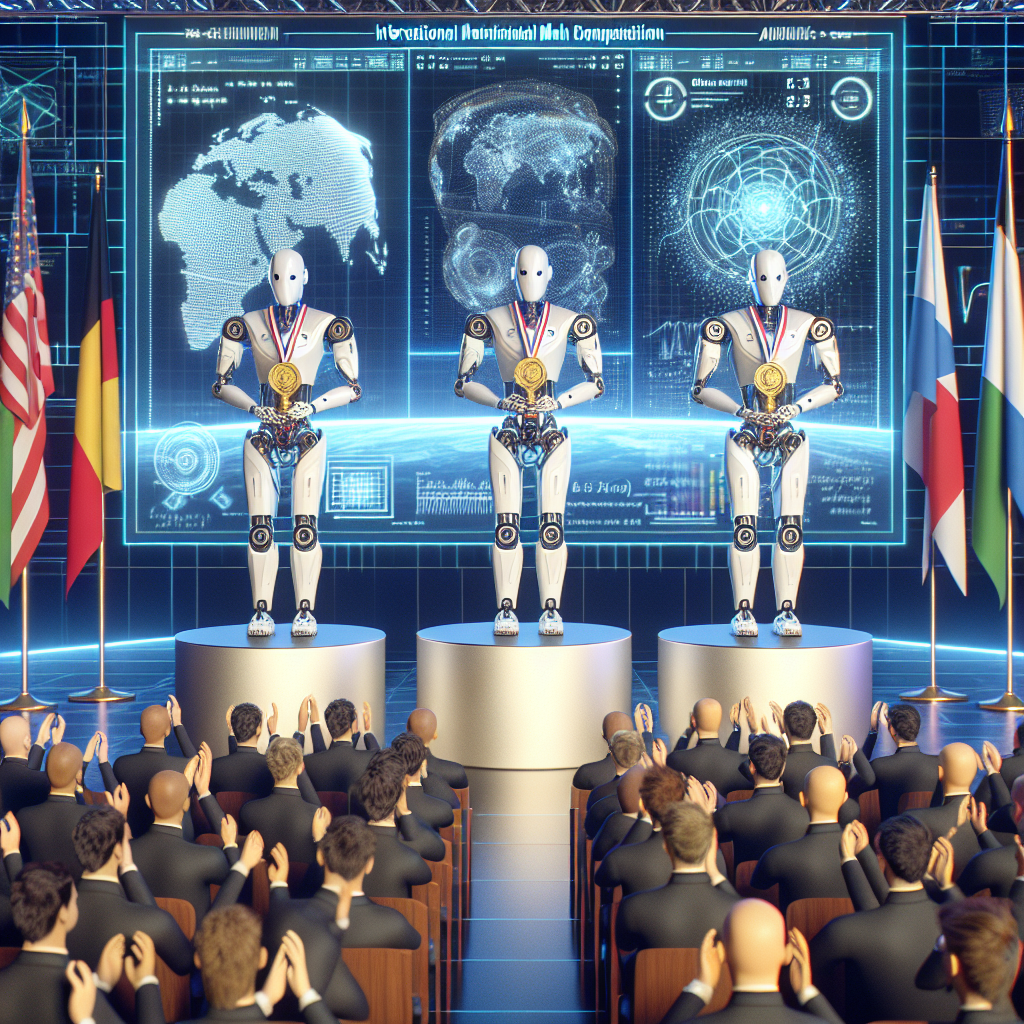
AI Breakthrough: Google and OpenAI Win Gold at International Math Olympiad
In a landmark moment for artificial intelligence and academic competition, AI models developed by Google DeepMind and OpenAI have clinched gold medals at the 2025 International Mathematical Olympiad (IMO). This marks the first time that AI systems have officially participated and succeeded in a global academic event traditionally reserved for elite high school students. The victory not only underscores the rapid advancement of AI capabilities but also poses important questions about the future of education, testing, and human-AI collaboration.
What Is the International Mathematical Olympiad?
The International Mathematical Olympiad is the most prestigious math competition for secondary school students globally. Founded in 1959, it gathers the brightest young minds from more than 100 countries each year to solve complex mathematical problems that range from algebra and combinatorics to geometry and number theory.
The 2025 edition of the IMO, held in Tokyo, Japan, was historic because it was the first time ever that AI models competed alongside human participants in a trial capacity. Though their participation was unofficial in terms of medal rankings, the performance level was evaluated by the same rigorous standards used for human competitors.
The AI Models Behind the Win
The show-stopping performances came from two AI powerhouses:
- Google DeepMind’s “AlphaGeometry”: A powerful model specifically tailored for advanced mathematical problem-solving using symbolic reasoning combined with neural processing.
- OpenAI’s “MathGPT”: Built upon the success of GPT-4 and later iterations, MathGPT integrates large language model capabilities with a dedicated mathematical problem-solving layer.
Both AI systems successfully solved five out of six Olympiad questions—matching or outperforming many human gold medalists.
How Did AI Solve Olympiad-Level Math?
These Olympiad problems are notorious for being too complex for most undergraduate students, let alone an algorithm. But AlphaGeometry and MathGPT tackled them by using a combination of:
- Neural-symbolic reasoning: Combining pattern matching of AI with formal mathematical proofs.
- Formal logic validation: Models could verify their steps against formal theorem databases, ensuring academic rigor.
- Reinforcement learning: AI agents were trained on past Olympiad questions and rewarded for creative, concise problem solving.
For decades, AI has struggled with symbolic reasoning—an integral part of solving math problems that require creative leaps. These new models represent a turning point, as both Google and OpenAI incorporated advances that bridge linguistic understanding with algorithmic mathematics at an elite level.
Implications of AI’s Victory in Mathematics
The implications of this achievement go far beyond bragging rights. AI’s success at the IMO can ripple across sectors:
1. Transformation of Education
AI tutors that can understand and teach high-level math are now closer to reality. This paves the way for:
- 24/7 personalized tutoring for students across all levels.
- Automated generation of custom problem sets and solutions tailored to each learner’s strengths and weaknesses.
- Removal of geographical and financial barriers to elite math education.
2. New Benchmarks for Algorithmic Reasoning
Solving IMO problems isn’t just about mathematics—it requires logic, creativity, and abstract thought.
By succeeding in this domain, AI models prove they can:
- Reason symbolically in unpredictable domains.
- Apply general intelligence outside traditional training data.
This places AI closer to Artificial General Intelligence (AGI)—a longstanding goal where machines can think and learn as humans do.
3. Changes in Competitive Standards
Top-performing AI systems at Olympiads could challenge the way standardized tests and academic competitions evolve. Some educators worry this may eventually “shift the finish line” in global academic contests, where human competitors are unfairly measured against near-perfect AI.
However, others see it as an opportunity to redefine the nature of learning and competition. Students might one day work alongside AI partners, using them not as competitors, but as collaborators.
Reactions from the Tech and Academic Worlds
The AI achievement was met with both amazement and apprehension. Here’s how various stakeholders reacted:
- Academics and educators praised the models for “expanding the definition of intelligence,” but urged education systems to adapt proactively.
- Tech leaders celebrated the milestone, saying it marks a step toward “machine-assisted scientific discovery.”
- Ethicists and policymakers raised concerns about dependability, accessibility, and the pressure these advancements place on students.
Nevertheless, some top math Olympiad winners, including last year’s gold medalist from the USA, noted that the human experience of solving a problem—feeling stuck, finding creative insights, making mistakes—still holds unique educational value that machines can’t replicate.
What’s Next for AI in Intellectual Competitions?
Following the success at the IMO, Google and OpenAI are expected to extend their models into other academic domains. Possible next steps include:
- Competing in International Physics and Chemistry Olympiads.
- Training specialized AI for university-level math challenges such as the Putnam Competition.
- Deploying AI models in research collaborations, where math and theoretical breakthroughs are urgently needed.
Moreover, schools and universities are beginning pilot programs to integrate these models into classrooms for collaborative learning and problem-solving.
Final Thoughts: AI’s Role in the Future of Math
The gold medal wins by Google and OpenAI’s AI systems at the 2025 International Mathematical Olympiad represent a paradigm shift in how we understand intelligence, education, and computational ability.
Rather than replacing human intelligence, these systems illuminate possibilities for enhanced learning, faster discovery, and deeper engagement with complicated intellectual challenges.
The world now stands at an educational and technological crossroads: either resist or embrace a future where human creativity and AI precision work side-by-side to push the boundaries of what’s mathematically possible.
Whether you’re a student, educator, tech leader, or just a curious enthusiast, one thing is certain—AI is solving problems once thought reserved only for human minds. And this is only the beginning.