
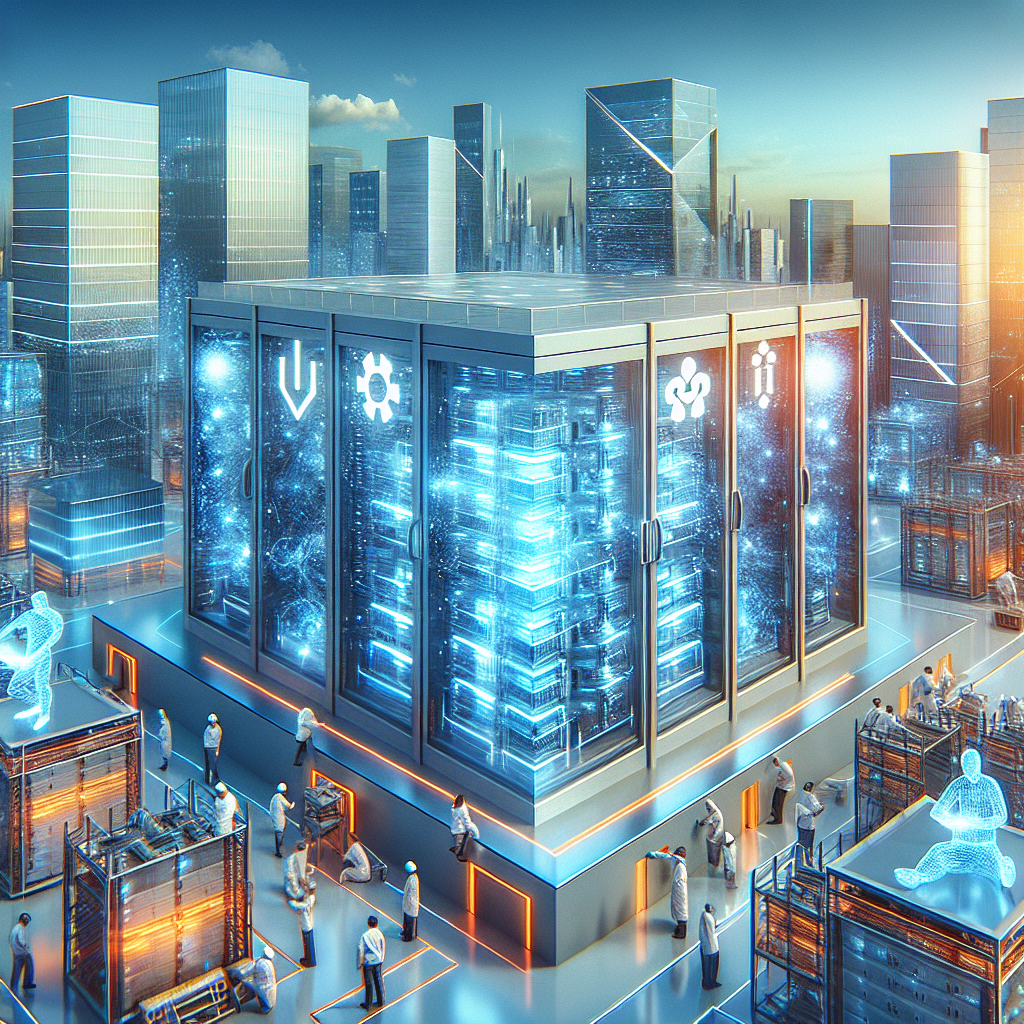
SoftBank, OpenAI’s Stargate to Build Data Center by Year-End
In a significant move to bolster the artificial intelligence (AI) infrastructure race, SoftBank and OpenAI’s Stargate project are joining forces to build a new data center, expected to launch by the end of 2025. The collaboration was revealed in a recent report by The Wall Street Journal, outlining a plan that could drastically shift the landscape of computing power for generative AI models.
The Vision: Accelerating AI’s Infrastructure Backbone
This forthcoming data center is part of a larger long-term objective from OpenAI’s CEO Sam Altman to develop an expansive, globally integrated compute system. Dubbed “Project Stargate,” the initiative is designed to provide next-level support for AI advancements — particularly the increasingly resource-intensive demands of large language models (LLMs).
According to reports, the facility aims to be an early prototype for what could be one of the most ambitious infrastructure undertakings in the tech sector. The goal? To create a robust foundation that can keep pace with the phenomenal growth of AI technologies.
Why SoftBank Is the Ideal Partner
SoftBank’s involvement underscores the magnitude of the project. Known for its strategic investments in emerging technologies and its influential Vision Fund, SoftBank is positioning itself at the heart of AI’s future infrastructure. It brings to the partnership:
- Deep capital reserves: The project would require billions of dollars over time, an amount SoftBank is well-equipped to provide.
- Global technology experience: With investments in companies like ARM and NVIDIA, SoftBank understands the ecosystem of semiconductors and processors that power data centers.
- Strategic planning expertise: SoftBank’s scale and reach provide the logistical support necessary for major infrastructure deployments.
Key Features of the Data Center
Though many technical specifications are still under wraps, some early insights reveal what the data center will embody:
- Smaller initial footprint: The first build, expected to be operational by the end of 2025, will be smaller in scale but serve as a proof of concept.
- High-performance computing (HPC) capabilities: It will be optimized to support AI workloads through densely packed GPU clusters.
- Sustainability focus: Both companies aim to incorporate renewable energy sources and efficient cooling technologies to meet environmental standards.
- Modular design: The facility is expected to be scalable, allowing for rapid expansion based on demand.
This pilot could pave the way for future data centers on a much grander scale — some reports suggest future centers may be up to 100 times larger than the initial build.
OpenAI’s Infrastructure Ambitions Take Shape
The Stargate project is not just about one facility. Instead, it’s the cornerstone of OpenAI’s broader strategy to control and scale its own compute resources. As AI models like ChatGPT evolve to new versions such as GPT-5 and eventually GPT-6, demand for compute will outpace traditional cloud solutions.
Here’s why this matters:
- Performance and latency: Proprietary infrastructure allows more control over AI model performance and the reduction of inference latency.
- Cost management: Operating in-house data centers can be more cost-effective than renting long-term cloud capacity from third parties like Microsoft Azure or Amazon Web Services.
- Security concerns: Dedicated facilities offer stronger control over intellectual property and sensitive data.
The AI Arms Race: Data Centers Are the New Battleground
This initiative reflects a growing trend: technology leaders are racing to build data centers tailored for AI. As large language models grow in size and complexity, traditional infrastructure is struggling to keep up. Custom data centers equipped with thousands of GPUs and specialized silicon are quickly becoming mission-critical.
Other tech giants like Amazon, Google, and Microsoft are also investing billions into next-gen data center architecture. With this move, SoftBank and OpenAI are ensuring they stay competitive amid the hyperscaler rivalry while gaining more autonomy over their operational futures.
Key Competitors in the AI Infrastructure Race
While OpenAI is partnering with SoftBank, others are also in full swing building their own AI infrastructure:
- Microsoft: Partnering with OpenAI on Azure, already deploying advanced AI supercomputers.
- Google: Leveraging custom-built TPU-powered servers across its global data center network.
- Amazon Web Services (AWS): Expanding its products like Trainium and Inferentia to support diverse AI clients.
SoftBank’s collaboration with Stargate will ensure that OpenAI doesn’t rely entirely on their existing Microsoft partnership for future infrastructure scalability.
Timeline and Expected Launch
According to the Wall Street Journal article, the pilot data center is slated for launch by the end of 2025, a relatively aggressive timeline for such a complex build. While the exact location remains undisclosed, some analysts speculate it could be built in regions offering favorable incentives for data infrastructure, including the U.S., Japan, or the Middle East.
This initial data center is intended to serve as a blueprint, allowing the Stargate team to test key concepts, optimize cooling systems, and trial management platforms for monitoring AI-specific workloads. If successful, larger facilities will follow — potentially with capacities large enough to support generalized AI (AGI) workloads in years to come.
Long-Term Implications for the AI Industry
The data center has major implications beyond just hardware. It could spark innovation in how we build, power, and scale AI systems. Here’s a look at the possible long-term impacts:
- Decentralization of AI infrastructure: In-house data centers could reduce tech companies’ dependence on cloud providers.
- Greater innovation in cooling and power efficiency: High-density computing drives new ways to manage heat, energy, and sustainability.
- New AI services and features: More computing power enables more real-time, personalized applications for users.
- Job creation and economic growth: These projects often bring high-paying technical and maintenance jobs to local economies.
Final Thoughts
With SoftBank and OpenAI’s Stargate teaming up to build a high-performance data center by the end of 2025, the AI sector is entering a new chapter. This partnership is not just about today’s infrastructure needs — it’s a forward-looking play to support the computational demands of tomorrow’s AI breakthroughs.
As the AI boom continues, companies that invest early in dedicated infrastructure will have an edge. With its new data center efforts, OpenAI is making a clear statement: control over compute is no longer optional — it’s essential for leading the AI revolution.